
Health
County’s veterans affairs director thanks veterans at VA ceremony
By Maya Rodriguez
Advertisement · Why this ad?
Holding a degree in Criminal Justice from East Stroudsburg University, Jessica has spent five years investigating local crime and safety issues, contributing to both the Citizens’ Voice and local news radio stations.
More from Jessica →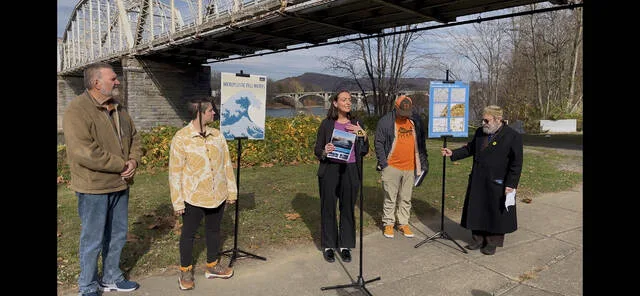
Home News Microplastic pollution common in Susquehanna River, Chesapeake Bay watershed Facebook Twitter Pinterest Linkedin ReddIt Email Print By Bill OBoyle [email protected] Samples pulled from Susquehanna, dozens of other waterways Officials at Tuesday’s news conference in Pittston regarding a new study released Tuesday by the statewide nonprofit PennEnvironment Research & Policy Center that found pervasive microplastic contamination across the Chesapeake Bay watershed are, from left: Brian Wagner, conservation chair, Pennsylvania Council, Trout Unlimited; Josephine Gingerich, health advocacy outreach coordinator, Physicians for Social Responsibility Pennsylvania (PSRPA); Flora Cardoni, deputy director, PennEnvironment Research & Policy Center; Bobby Hughes, executive director, Eastern PA Coalition for Abandoned Mine Reclamation (EPCAMR) and member of the Chesapeake Bay Program Stakeholders’ Advisory Committee (SAC); Rabbi Daniel Swartz, executive director, The Coalition on the Environment and Jewish Life (COEJL). Adrian Suppes | 28/22 News 🔊 Listen to this PITTSTON — Flora Cardoni, deputy director with PennEnvironment Research & Policy Center, said Tuesday that results from a recent study should set off alarms for all Pennsylvanians who love the Susquehanna River and all the rivers and streams throughout the Chesapeake Bay watershed. Cardoni said a new study released Tuesday by the statewide nonprofit PennEnvironment Research & Policy Center found pervasive microplastic contamination across the Chesapeake Bay watershed. The report — “Microplastics in the Chesapeake Bay Watershed” — shows microplastics in every water sample taken from nearly two dozen rivers, lakes and bayfront locations in the Chesapeake Bay watershed, including the Susquehanna River. “Microplastics throughout the Chesapeake Bay and its tributaries make it clear we can no longer ignore the increasingly common specter of plastic pollution,” Cardoni said. The Chesapeake Bay watershed is home to thousands of animal species and provides drinking water to nearly 13 million people. Researchers took water samples from the Chesapeake and its tributaries within four of the river’s watershed states — Pennsylvania, New York, Maryland, and Virginia — plus Washington, D.C. They tested them at the Academy of Natural Sciences in Philadelphia. “Microplastics in our water is the result of decades of petrochemical production in a frack-friendly state,” said Josephine Gingerich, health advocacy outreach coordinator, Physicians for Social Responsibility Pennsylvania. “The entire life cycle of gas and petrochemicals is an assault on public health.” Microplastics are pieces of plastic less than 5 millimeters in size, which is smaller than a grain of rice. They represent a growing area of concern for the health of wildlife and people. Due to their small size, microplastics can suffocate animals or cause them to starve. Microplastics in the environment can also stick to toxins — such as PFAS chemicals and PCBs — and sicken the wildlife that eat them. They have also been found in human bodies. The report outlines a broad range of policy solutions to tackle the problem, including: • Introducing producer responsibility legislation and bottle deposit legislation in states where these don’t already exist to make plastic manufacturers responsible for the waste they create • Passing single-use plastic bans at the local, state, and federal levels where they have not already been passed • Passing state and federal restrictions on the dumping of pre-production plastic pellets (often called nurdles) Local efforts are also underway to clean up waterways in the area. “EPCAMR leads dozens of illegal dumping cleanup efforts where we are always cleaning up plastics, trash bags, tires, and household hazardous waste,” said Bobby Hughes, executive director, Eastern PA Coalition for Abandoned Mine Reclamation (EPCAMR). “Leaving this blight and trash in our environment and along our waterways could lead to the breakdown into microplastics in our stream and river systems that flow into the Susquehanna and eventually down to the Chesapeake Bay.” A full list of the types of microplastics at each sampling location can be found in the report . “There is no silver bullet solution for the mini-menace of microplastics,” said Cardoni. “Fundamentally, we need to cut plastic pollution off at the source and change the way society deals with our waste, if we want to protect our environment and our health from this threat.” Local journalism matters, and your support makes it possible. You can help sustain this work by making a donation or choosing one of our subscription options. Subscribers enjoy valuable benefits, including full access to our e-edition, a reduced ad experience on timesleader.com, and more. Your support helps ensure independent, high-quality local news remains available today and for future generations. Thank you for standing with local journalism. Click for subscription offers. Reach Bill O’Boyle at 570-991-6118 or on Twitter @TLBillOBoyle.
By Maya Rodriguez

By David Kim

By Rachel Montoya

By Ethan J. Mulligan